Inventory Management Software for Security Companies | Canticle Technologies
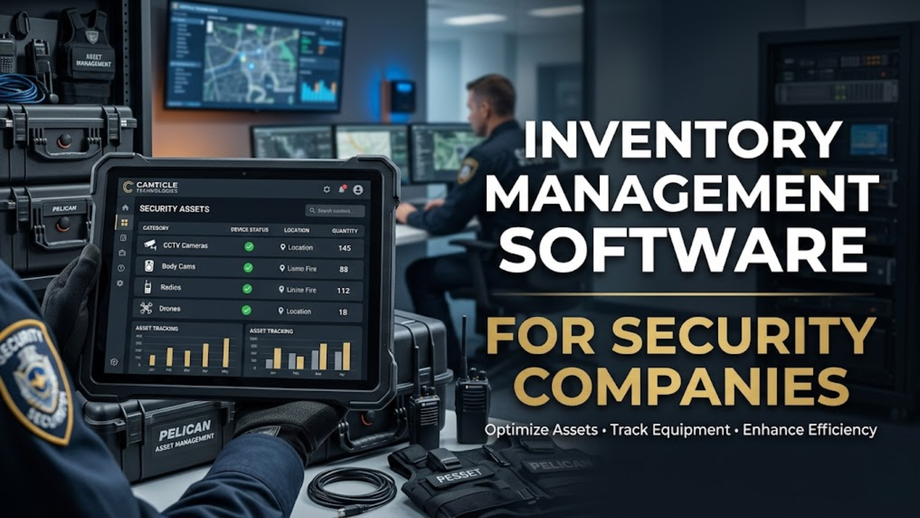
Inventory Management Software for Security Companies: Track Every Uniform, Every Asset, Every Site — Without a Single Spreadsheet
Security agencies manage far more than people. Every guard deployed at a client site is wearing a uniform your company owns. They are carrying equipment your company issued. They have been given a firearm, a torch, a walkie-talkie, or a baton that belongs to your inventory. Across 50 client sites, with 500 guards rotating through shifts, that is thousands of individual items in circulation — issued, in use, returned, lost, damaged, or pending replacement.
Most security agencies track this on Excel, in paper registers, or not at all. The result is predictable: uniforms go missing with no accountability, equipment gets issued twice to the same person, stock at one branch runs short while another branch has surplus, and at year-end nobody can explain why the inventory cost is significantly higher than it should be.
Canticle Technologies' inventory management software for security companies is built as part of the Guardium ERP platform — a module that controls and monitors the full inventory lifecycle across all branches and sites, from purchase orders and stock receipt to guard-level issuance, return tracking, and GST-ready billing.
Why Inventory Management Is a Serious Problem for Security Agencies
A security agency's inventory is not a back-office concern — it is a front-line operational requirement. Guards cannot be deployed without a proper uniform. Client-site compliance often requires specific equipment to be present and functional. Firearm-licensed guards need their weapons accounted for at every shift change.
When inventory management is manual or absent, the problems are both operational and financial:
Unrecovered uniforms from exiting guards. When a guard leaves the company, their uniform should be returned and recorded. Without a system that tracks issuance at the individual guard level, companies have no record of who was issued what — and recovering uniforms at exit becomes a guess rather than a documented process. Over a year, across hundreds of exits, unrecovered uniforms represent significant replacement costs that come directly off the bottom line.
Equipment issued twice or not at all. Without a central issuance record, the same equipment — walkie-talkie, torch, baton — can be issued to one guard, never returned in the register, and then issued again to someone else while the original item is still in the field. Simultaneously, a guard at a different site may genuinely need equipment and find none available because the system shows it as still in stock.
No visibility across branches. Security agencies operating across multiple cities or branches keep their inventory locally at each branch. Without a central system, head office has no view of total stock levels, low-stock alerts, or inter-branch transfers. A branch in Delhi may order new uniforms while a branch in Noida has 50 sitting unused.
GST and billing errors on inventory purchases. Security companies make regular purchases — uniforms from vendors, equipment from suppliers, consumables for client sites. Without structured purchase order and vendor management, GST input credits are missed, vendor payments are delayed or duplicated, and the finance team struggles to reconcile procurement costs with billing.
No accountability for damaged or lost items. Without a system that tracks condition at issuance and return, damaged items are written off informally, lost items go unrecorded, and there is no data to support recovery from a guard's final settlement.
Canticle's inventory module closes every one of these gaps with a structured, cloud-based system that connects inventory management directly with the guard management, HRMS, and payroll modules that already know who is deployed where and when.
What Canticle's Inventory Management Software Covers
Canticle's inventory module is designed specifically for the type of inventory security agencies manage — not products for sale, but operational assets issued to people at specific locations for specific durations. The system covers the complete inventory lifecycle:
Item Master and Category Setup
Before any tracking begins, Canticle's system allows you to define your complete inventory catalogue with precision. Each item is configured with:
-
Item name, category, and subcategory — uniforms, equipment, safety gear, consumables
-
Size and variant details — shirt size, trouser size, shoe size for uniform items
-
Unit of measurement
-
Purchase price and sale or recovery price
-
Minimum stock level threshold for low-stock alerts
-
Vendor details for each item category
This structured item master ensures that every transaction in the system — issuance, return, transfer, purchase — is recorded against a defined item, not a free-text entry that creates inconsistency across branches.
Purchase Orders and Vendor Management
Every inventory item your agency buys — from uniforms ordered from a supplier to equipment purchased for a new client contract — is processed through Canticle's purchase order module.
The purchase workflow includes:
-
Raise a purchase order against a registered vendor with item quantities, rates, and delivery details
-
Goods receipt note (GRN) raised when stock is physically received, updating inventory levels automatically
-
Purchase return management for items that need to be returned to vendors due to quality issues or order changes
-
Vendor reports showing order history, pending deliveries, and payment status per vendor
-
GST-compliant billing for all purchases — input tax credit tracking built into every vendor transaction
For security agencies that regularly procure uniforms seasonally or equipment for new client contracts, this structured procurement flow ensures every rupee spent is accounted for, every GST credit is captured, and no purchase goes through without proper documentation.
Multi-Branch Stock Management
For agencies with operations across multiple cities or branch offices, Canticle's inventory module provides multi-branch stock visibility from a single central dashboard.
Each branch maintains its own stock ledger — receiving items from head office, managing local issuance, and tracking returns at the branch level. Head office sees the aggregate picture:
-
Total stock across all branches by item
-
Branch-wise stock levels with low-stock indicators
-
Pending stock requests from branches
-
Inter-branch stock transfers — moving surplus stock from one branch to where it is needed
This eliminates the situation where one branch over-orders while another runs short — a routine problem for agencies managing procurement from head office without visibility into branch-level stock.
Stock transfers between branches are processed as formal transactions in the system — with a transfer note raised at the source branch, confirmed at the receiving branch, and automatically reflected in both branch ledgers. Every transfer has a record, a date, and a quantity — preventing the informal "we sent some uniforms over" conversations that never make it into any register.
Guard-Level Uniform and Equipment Issuance
The most operationally important feature of Canticle's inventory module is guard-level issuance tracking — the ability to record exactly which items were issued to which guard, on which date, at which site.
When a guard is onboarded or transferred to a new site, the site officer or HR team records the items issued directly in the system:
-
Uniform items — shirt, trousers, belt, cap, shoes — with sizes
-
Equipment — torch, baton, walkie-talkie, handcuffs — with serial numbers where applicable
-
Safety gear — reflective vest, helmet, protective gloves
-
Firearm and accessories — license number, weapon serial number, ammunition issue record
Each issuance record is timestamped and linked to the guard's HRMS profile. The system shows, at any point, the complete list of items currently held by each guard across all sites.
This guard-level tracking solves the single biggest inventory accountability problem in security agencies: knowing what each person has, so you can recover it when they leave.
Return Management and Exit Recovery
When a guard exits the company — resignation, termination, or end of contract — Canticle's inventory module generates a clearance checklist based on the issuance record for that guard.
The site officer or HR team marks each item as returned, damaged, or not returned. For items not returned or returned in damaged condition, the recovery amount — based on the item's configured recovery price — can be automatically flagged for deduction from the guard's full and final settlement through the integrated payroll module.
This closes the loop that most security agencies leave open: the guard leaves, the uniform stays unreturned, and there is no record or recovery mechanism in place. With Canticle, the system enforces the process because the payroll module waits for clearance confirmation before releasing the final settlement.
Real-Time Stock Reports and Low-Stock Alerts
Canticle's inventory reporting gives management and procurement teams the data they need to make timely decisions without waiting for end-of-month stock audits.
Available reports include:
-
Current stock report — real-time quantity by item, by branch, and in total
-
Issuance report — all items issued over a date range, by guard or by site
-
Return report — all items returned, with condition status
-
Low-stock alert dashboard — items that have fallen below the configured minimum threshold, triggering procurement action before stock actually runs out
-
Guard-wise outstanding inventory report — list of every guard currently holding company assets, what they hold, and since when
-
Pending clearance report — exiting guards who have not yet completed inventory return
-
Vendor-wise purchase report — total procurement by vendor, by item, with GST details
-
Damage and loss report — items written off, with approval records
These reports eliminate the need for manual stock audits, give procurement teams advance notice before stockouts occur, and provide the data needed to negotiate better terms with uniform and equipment vendors based on actual consumption history.
GST-Ready Billing for Inventory Transactions
Security companies in India operate under GST for both purchase and client billing. Canticle's inventory module is built with GST compliance at its core — covering input tax credit on purchases, GST on stock transfers between branches of the same entity, and accurate vendor invoicing.
Every purchase order and goods receipt note captures GST components — CGST, SGST, and IGST as applicable. The system supports multi-GST rate configurations for different item categories. Vendor invoices are matched against purchase orders within the system, reducing the chance of tax credit mismatches during GSTR filing.
For security agencies that have faced reconciliation challenges between procurement records and GST returns, this built-in GST structure removes a significant manual accounting burden from the finance team.
How Inventory Connects to the Rest of Canticle's ERP
Canticle's inventory module is not a standalone tool — it is one module within the Guardium ERP platform, and its value increases significantly because of how it connects with the other modules your agency already uses.
Connection with Onboarding: When a new guard is onboarded through Canticle's digital onboarding system, their issuance record in inventory is created simultaneously. The site officer records what was issued at joining, and the guard's HRMS profile shows outstanding inventory from day one.
Connection with HRMS: Guard transfers between sites trigger an inventory review — items assigned to the guard at their old site are checked against requirements at the new site. Equipment that needs to stay at the old site can be formally returned and re-issued to the incoming guard.
Connection with Payroll: Unrecovered inventory items at exit are flagged as deductions in the full and final settlement process. The payroll module receives the recovery amount directly from the inventory clearance record — no manual calculation or inter-department communication required.
Connection with Billing: For agencies that charge clients for specific equipment deployed at their site — or that include uniform costs in contract billing — the inventory module's issuance data supports accurate client-wise cost allocation and billing.
Who This Module Is Built For
Canticle's inventory management module delivers the most value to:
-
Security guard agencies managing uniforms and equipment across multiple client sites and branches
-
Manpower supply companies issuing branded uniforms and safety gear to deployed workers
-
Facility management and housekeeping agencies tracking cleaning equipment, supplies, and branded uniforms
-
Armed security companies with strict accountability requirements for firearms, ammunition, and licensed equipment
Any business where physical assets are issued to field staff at multiple locations — and need to be tracked, recovered, and accounted for — will find Canticle's inventory module removes a category of operational risk that most agencies simply tolerate until it becomes expensive.
Frequently Asked Questions
Can we track inventory separately for each branch and client site, or is it one combined pool?
Both. Each branch maintains its own stock ledger and issues from its local stock. Head office has a consolidated view across all branches simultaneously. You can drill down to a specific branch or zoom out to see total company-wide stock for any item at any time.
How does the system handle uniform sizes for guards of different builds?
Uniform items are configured in the item master with size variants — Small, Medium, Large, XL, and so on. When issuing a uniform to a guard, the specific size is recorded. Stock levels are tracked per size, so low-stock alerts fire for specific sizes rather than just overall quantity — preventing situations where stock shows as available but the right size has run out.
Can we set a minimum stock level and get alerts before we run out?
Yes. Each item in the system has a configurable minimum stock threshold. When stock at any branch falls below that level, the system generates a low-stock alert for the procurement team. This gives you time to raise a purchase order before stock runs out, rather than discovering the shortage when a guard needs a uniform and none is available.
What happens if a guard damages a uniform rather than losing it — how is that handled differently?
During the return process, the site officer records the condition of each returned item — Good, Damaged, or Not Returned. Damaged items are written off from usable stock but remain in the damage report for accountability. If a recovery deduction applies for damaged items, that amount is configured per item and flagged for payroll deduction during full and final settlement — separately from a full non-recovery.
Can we track serialised equipment — like walkie-talkies with individual serial numbers?
Yes. Equipment items that have individual serial numbers can be configured as serialised assets in the system. Each serial number is recorded at issuance and matched at return, so you know exactly which device is with which guard rather than just a quantity count.
How does inventory recovery work during an employee's exit process?
When a guard's exit is initiated in the HRMS module, the system generates a clearance checklist based on all outstanding inventory in their name. Each item is marked as returned, damaged, or not recovered by the HR or site officer. Any unrecovered or damaged amount is automatically calculated based on the item's recovery price and passed to the payroll module for deduction from the full and final settlement — no manual calculation needed.
Does the system support inter-branch stock transfers with proper documentation?
Yes. Stock transfers between branches follow a formal transfer note workflow — the sending branch raises a transfer note, the receiving branch confirms receipt, and both branch ledgers update automatically. Every transfer has a timestamp, quantity, and confirmation record.
Is the inventory module GST-compliant for purchase transactions?
Yes. All purchase orders, goods receipt notes, and vendor invoices are processed with GST components — CGST, SGST, and IGST — based on the vendor's location and the transaction type. The system supports multiple GST rates across different item categories and generates purchase reports that reconcile with GSTR filing requirements.
Can we see which guards are currently holding company assets and what they have?
Yes. The guard-wise outstanding inventory report shows every guard currently holding company assets — what items they have, in what quantity, since which date, and at which site. This report is available at any time and is particularly useful before payroll cycles and during client audits where you need to demonstrate asset accountability.
Security agencies that manage inventory on spreadsheets are carrying a cost that compounds silently every month — in unreturned uniforms, untracked equipment, missed GST credits, and procurement decisions made without accurate data. Canticle Technologies' inventory management software gives security companies the structure, visibility, and accountability they need to manage every asset, at every site, with complete confidence.
Book a demo at canticleindia.com and see how Canticle's inventory module works as part of the complete Guardium ERP platform for security companies.
https://canticleindia.com/products/payroll-software-for-security-guard-companies.htm
.png)


Comments
Post a Comment